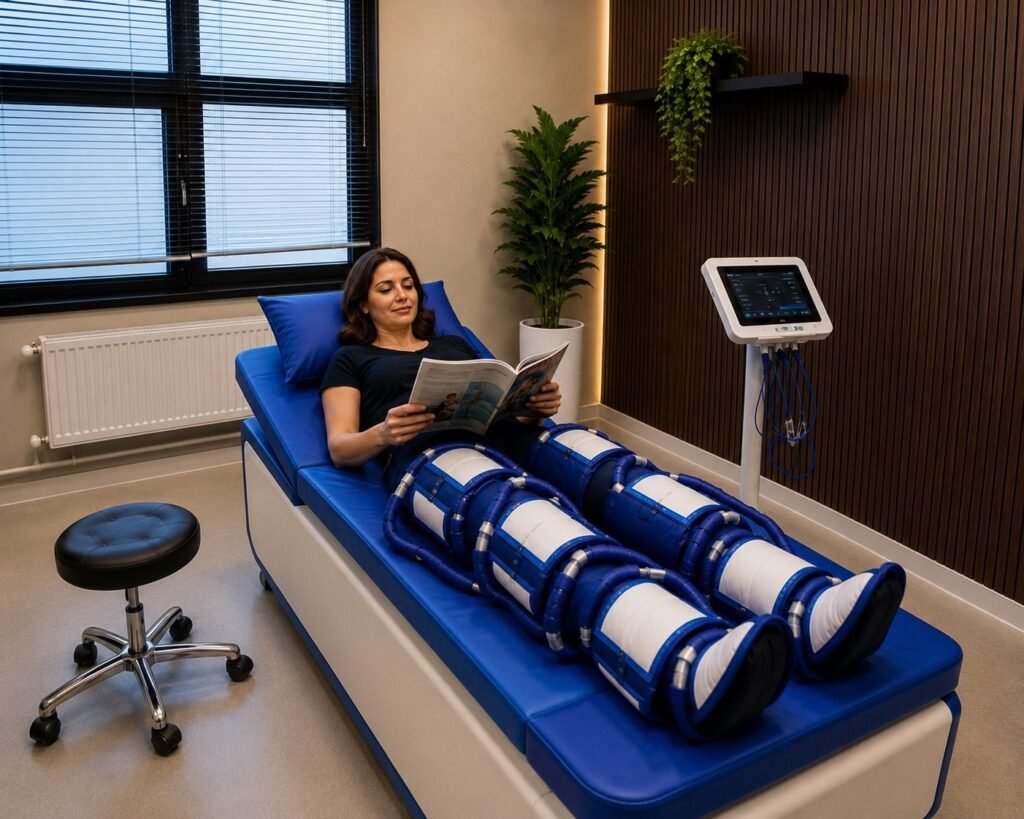
EECP therapy is studied for its effect on chest pain, exercise capacity and everyday quality of life, mainly in people with coronary disease. This page shows what is known for each condition and how strong the evidence is.
EECP (enhanced external counterpulsation) is a non-surgical therapy in which cuffs on the legs inflate and deflate in time with the heartbeat. Its best-supported use is chronic angina and heart failure symptoms linked to coronary disease.
Other topics below are less well established. Each card opens a page that states the evidence level openly. No treatment can promise results, and EECP never replaces your doctor’s care.
Heart and circulation topics where EECP is most often discussed.
May help ease chest pain, breathlessness and fatigue linked to narrowed coronary arteries.
Supports heart function and exercise capacity in heart failure related to blocked arteries.
Considered for chest pain and fatigue linked to circulation problems in the heart’s small vessels.
Supports recovery and circulation after stent placement or bypass surgery.
Explored as a way to support endurance, cardiac performance and exercise capacity in athletes.
Heart-attack prevention rests on proven measures; EECP is studied as a supportive option for coronary symptoms.
Learn what current research says about blood pressure and vascular function.
A medical consultation helps you understand whether EECP is relevant to you.
Topics where research is earlier. Each page states its evidence level.
An early-stage, supportive option under study alongside stroke rehabilitation.
Stroke prevention rests on risk-factor control; see where EECP may and may not fit.
An investigational topic: what early research does and does not show.
No treatment is proven to prevent dementia or Parkinson’s; see what is known about vascular health.
Studied as a supportive option for erectile problems linked to impaired blood flow.
Early research on mood and quality of life in people with heart and vascular disease.
Supportive circulation care in diabetes; evidence on complications is limited.
Supportive circulation care in diabetes, with limited evidence on complications.
Studied as a supportive option for vascular-related sexual health concerns.
Urgent care comes first; EECP is only an investigational add-on in selected cases.
Emergency eye care comes first; EECP is only an investigational add-on.
Early research on lingering fatigue and breathlessness after Covid-19.
May support circulation and activity in older adults with coronary disease.
Early findings on well-being in people with heart conditions.
May help support deeper, more restful sleep.
Early, limited research on circulation in ischaemic eye conditions.
Very limited evidence: see what is known about vascular parkinsonism.
A medical consultation helps you understand whether EECP is relevant to you.
Conceptual illustrations and illustrative examples of how improved blood flow is described. These are not patient outcome images and not results of individual patients.


How EECP is thought to work.
Leg cuffs inflate between heartbeats and push blood back toward the heart, raising flow through the coronary arteries.
Studies report better function of the inner lining of blood vessels after a course of EECP.
The cuffs deflate just before the next beat, which may reduce the pressure the heart pumps against.
Repeated sessions are proposed to encourage small alternative vessels to open. This is a hypothesis, not proven.
What patients in studies most often report.
Fewer angina episodes in many patients with chronic angina.
Walking, stairs and daily tasks may feel easier.
Many people report more energy through the day.
Some patients need less nitroglycerin.
Results vary between people and are not guaranteed.
sessions
per session
typical course
outpatient therapy
After a medical review, EECP may be considered for people who:
No treatment can guarantee that. Some patients report relief lasting months or years, others less. Follow-up care and risk-factor control matter.
Some people notice a difference during the course, often in the later weeks. Responses vary.
No. It is used alongside your treatment, never instead of it.
Tell us about your condition and we will explain, honestly, whether EECP may be appropriate.
This page is general information, not medical advice. EECP does not replace your doctor’s treatment, and results vary from person to person.