
In Sleep Disorders EECP Support
Long-lasting insomnia can lead to daytime fatigue and problems with attention and mood. According to guidelines, the first treatment is cognitive behavioral therapy for insomnia. In a small sham-controlled study, EECP improved sleep quality.
- Non-surgical
- 35 Sessions
- Painless
In brief
May help improve sleep disorders and support deeper, more restful sleep.
In chronic insomnia, the strongly recommended first treatment is cognitive behavioral therapy for insomnia.
In a sham-controlled study of 46 people, EECP improved the sleep quality score more than sham treatment.
Evidence is limited; sleep was not measured with objective devices. A larger study by the same team is ongoing.
What Happens in the Body With Insomnia?
Chronic insomnia can appear as difficulty falling asleep, frequent waking or waking too early. When it lasts long, daytime fatigue, attention problems and mood changes can appear. That is why the cause of the sleep problem should be investigated first.
Sleep pattern
The sleep-wake cycle is controlled by the brain. Stress, an irregular lifestyle, some medications and illnesses can disrupt this cycle.
Attention and mood
Insufficient sleep can negatively affect attention, memory and mood. Insomnia can also occur together with anxiety.
Inner vessel lining
In the insomnia study, the vessel dilation response also improved in the EECP group. How this change relates to sleep is not yet clear.
Hover over or tap the cards: the related area is highlighted in the illustration.
Heart and blood pressure
According to expert opinion, EECP has also been tried for insomnia related to heart disease and high blood pressure. That is why a cardiac evaluation before treatment is important.
Stress and pulse
Restlessness and a faster pulse on getting into bed can make it harder to fall asleep. Relaxation techniques are among the methods recommended in the guideline.
Daytime fatigue
Poor sleep can cause low energy during the day and reduced productivity at work. That is why studies also measure quality of life separately.
Sleep Quality: Before and With EECP
The comparison below shows in simple form the support targeted with EECP. The effect varies from person to person; your sleep is monitored with scales and a sleep diary.
Chronic insomnia
- Difficulty falling asleep and frequent waking
- Daytime fatigue and attention problems
- Anxiety and restlessness
Additional support alongside treatment
- The aim is an improvement in the sleep quality score
- Follow-up with a sleep diary
- Cognitive behavioral therapy continues as before
Schematic illustration. EECP is not the first-line treatment for insomnia.
How Is EECP Applied?
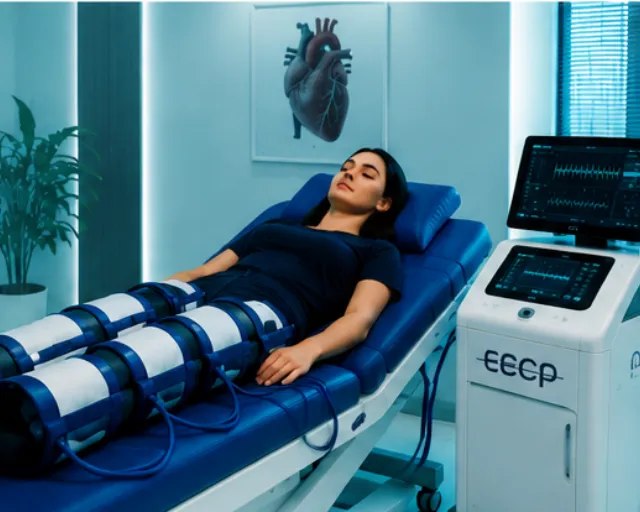
During treatment you lie down and rest. The device monitors your heart rhythm with an ECG and controls the cuffs accordingly.
Cuffs inflate
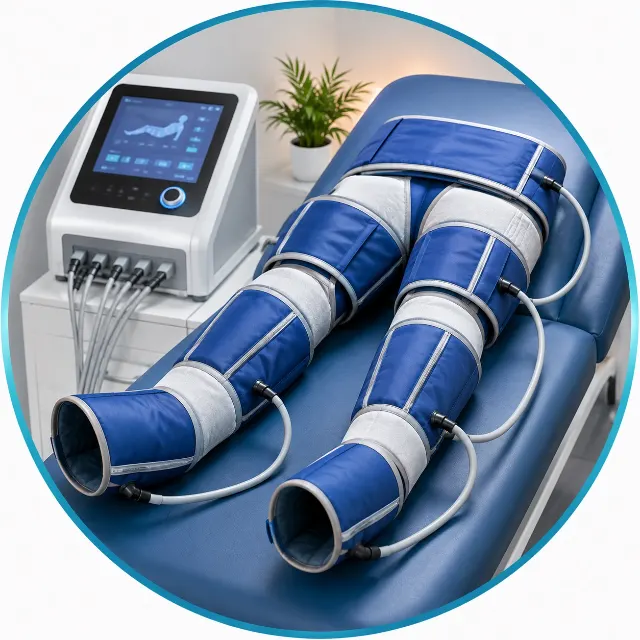
While the heart relaxes, the cuffs on the calves, thighs and buttocks inflate in sequence: first the calves, then the thighs and buttocks.
Blood flow increases
Cuff pressure speeds up flow in the vessels and stimulates the inner vessel lining. You rest throughout the session.
The heart's workload is reduced
The pressure is released just before the heart contracts, so the heart can pump more easily. This cycle repeats with every heartbeat.
Sleep is monitored
The sleep quality scale and sleep diary are compared before and after the course. Results are reviewed with you.
What Has Been Reported in Studies?
Response varies from person to person. The following are aims and gains reported in studies.
Sleep quality
In the sham-controlled study, the sleep quality score improved significantly more in the EECP group than in the sham group.
Sleep duration
Total sleep time and sleep efficiency increased in the EECP group; this difference persisted at the 3-month follow-up.
Mental quality of life
The mental component of quality of life was better in the EECP group, and the difference persisted at 3 months.
Vascular function
The vessel dilation response also improved in the EECP group.
Straight back to daily life
After the session you can return to your daily tasks straight away.
Guideline treatment
The guideline recommends cognitive behavioral therapy as the first treatment for chronic insomnia, with a strong recommendation.
Who Is It Suitable For, and Who Not?
First, the cause of the insomnia is investigated; factors such as sleep apnea, medications in use and mood are evaluated. The decision on EECP is made by our cardiologist, in line with your sleep treatment.
✓May be suitable
- Adults with chronic insomnia lasting at least three months
- People whose sleep problem persists despite cognitive behavioral therapy
- Patients with a sleep problem accompanying heart or vascular disease
- People with anxiety complaints accompanying insomnia who have been evaluated from a cardiac standpoint
✕Not suitable
- Suspected untreated sleep apnea: a sleep evaluation is needed first
- Severe aortic valve regurgitation
- Aortic aneurysm
- Active deep vein thrombosis, vein inflammation
- Uncontrolled high blood pressure
- Severe rhythm disorders
- Marked bleeding tendency and pregnancy
How Does the Treatment Process Work?
Blood pressure and pulse are checked before every session. At the end of the course, results are reviewed with our cardiologist. Sleep patients may be asked to keep a sleep diary during the course; this makes it easier to evaluate results.
Frequently Asked Questions About Sleep Disorders and EECP
Will EECP fix my sleep?
In a small sham-controlled study, the sleep quality score improved more with EECP than with sham treatment. The result is promising but needs to be confirmed in larger studies.
Can I have EECP instead of a sleeping pill?
The medication decision belongs to your doctor. According to guidelines, the first treatment for chronic insomnia is cognitive behavioral therapy; EECP does not replace these treatments but may be considered alongside them.
How long does the effect last?
In the study, the improvement in sleep quality persisted at the 3-month follow-up. Longer-term results are not yet known; a larger study with a 12-month follow-up is ongoing.
I snore and stop breathing at night. Is EECP suitable?
These complaints can point to sleep apnea and require a sleep evaluation first. We have not read a study examining the effect of EECP on sleep apnea; we do not promise any benefit in this regard.
Will I keep taking my medication?
Yes. You should continue your medication as recommended by your cardiologist. Any change to medication is decided only by your doctor.
How many sessions are needed?
The standard course is 35 sessions: 5 days a week, 60 minutes per session. In the insomnia study 35 sessions were given, and each lasted 45 minutes.
You May Also Be Interested In



Contact us for a free preliminary assessment
If your sleep problems have lasted a long time, let's evaluate them together. Our cardiologist tells you openly whether EECP is suitable for you. If needed, we refer you to a sleep specialist.
- Non-surgical
- Painless
- Under medical supervision
- Nicosia, Cyprus