
EECP in Athletes and Heart Performance
Intense training places a load on the heart and muscles. EECP is a non-surgical method that supports circulation with cuffs wrapped around the legs. It is being studied for recovery in athletes; results are still mixed.
- Non-surgical
- 35 Sessions
- Painless
In brief
Its effect on heart performance, endurance and exercise capacity in athletes is still being studied.
Evidence is limited and mixed: one study found a benefit for recovery, two studies found no added benefit.
It is applied lying down; the standard course is 35 sessions, 5 days a week, 60 minutes per session.
A cardiology assessment is done beforehand. EECP does not replace your training, sleep and nutrition plan; it is considered in addition to them.
What Happens in the Body During Training?
During exercise the heart beats faster and harder, and more blood goes to the muscles. After intense training, the body takes time to recover. This time affects the quality of the next session.
A heart that pumps more
During exercise the heart pumps more blood every minute. Regular training improves the heart's adaptation to this load.
Oxygen exchange
The lungs deliver oxygen to the blood and remove carbon dioxide. During intense effort, breathing becomes faster and deeper.
Heart rate variability
After training, the nervous system gradually shifts to its resting pattern. Heart rate variability is one of the measures used to monitor recovery.
Hover over or tap the cards: the related area is highlighted in the illustration.
Tired muscles
During intense effort, lactate builds up in the muscles and muscle fibres are strained. After movements such as jumping, muscle soreness can last a day or two.
Area where the cuffs are wrapped
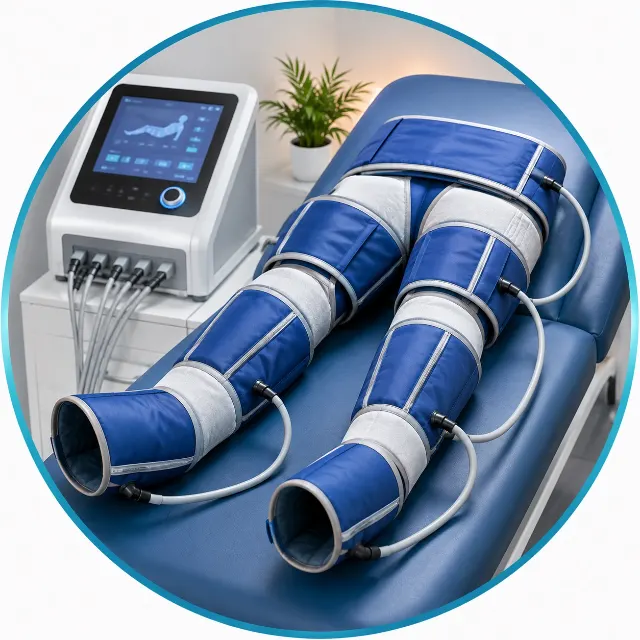
EECP cuffs are wrapped around the calves, thighs and buttocks. This area contains the body's largest muscle groups.
Venous return
Muscle contraction pushes blood in the veins back to the heart. When resting without moving, this pump effect decreases and blood returns more slowly from the legs.
After Intense Training: Before and With EECP
The comparison below simply illustrates the recovery support EECP aims to provide. The effect varies from person to person; for this reason your response is monitored with measurements throughout the sessions.
After intense training
- Heavy, tired legs
- Performance drops in a second session on the same day
- Limited time to recover
Passive, cuff-assisted recovery
- Circulatory support in sync with the heartbeat
- Applied lying down, without effort
- Individual response is monitored with pulse and tests
Schematic illustration. EECP does not replace rest or the training plan.
How Does EECP Support Circulation?
During treatment you lie down and rest. The device monitors your heart rhythm with an ECG and controls the cuffs accordingly.
Cuffs inflate
While the heart relaxes, the cuffs on the calves, thighs and buttocks inflate in sequence: first the calves, then the thighs and buttocks.
Blood returns to the heart
Cuff pressure pushes blood in the legs toward the heart. The amount of blood returning to the heart increases.
The heart's workload is reduced
The pressure is released just before the heart contracts, so the heart can pump more easily. This cycle repeats with every heartbeat.
Recovery is monitored
Pulse and blood pressure are measured before and after the session. If needed, a comparison is made with performance tests.
What Has Been Studied in Athletes?
Response varies from person to person. The following are aims and gains reported in studies.
Recovery within the same day
In one study, a 20-minute application reduced the performance drop in a second running test on the same day.
Feeling of recovery
In the same study, athletes reported feeling better recovered.
Athletes with ECG changes
In national-team athletes, aerobic endurance increased when it was applied together with hyperbaric therapy.
Passive application
You lie down and rest throughout the session; the support is delivered entirely passively.
Medical supervision
Sessions are carried out under the supervision of a cardiologist; pulse and blood pressure are monitored regularly.
Straight back to daily life
After the session you can return to your daily tasks straight away.
Who Is It Suitable For, and Who Not?
A cardiology examination is done before EECP. Complaints such as chest pain, fainting or palpitations are investigated first. The decision is made individually by our cardiologist.
✓May be suitable
- Athletes with an intense training programme whose heart and vessels have been assessed
- Athletes with ECG changes under the follow-up of a sports physician and cardiologist
- Adults who exercise regularly and are looking for recovery support
- People returning to sport after heart disease with their doctor's approval, whose recovery needs close monitoring
✕Not suitable
- People with chest pain, fainting or palpitations who have not yet been assessed
- A new muscle tear or serious injury in the leg
- Severe aortic valve regurgitation
- Aortic aneurysm
- Active deep vein thrombosis, vein inflammation
- Uncontrolled high blood pressure
- Severe rhythm disorders
- Marked bleeding tendency and pregnancy
How Does the Treatment Process Work?
Blood pressure and pulse are checked before every session. At the end of the course, results are reviewed together with our cardiologist. For athletes, session times can be planned around the training calendar.
Common Questions About EECP in Athletes
Does EECP improve performance in athletes?
The evidence is mixed. One study saw a smaller performance drop in a second running test on the same day. Two studies found no added benefit for recovery.
When is EECP considered in athletes?
It is generally discussed as recovery support during intense training and competition periods. For athletes with ECG changes, a sports physician and cardiologist assess together.
How many sessions are needed?
The standard course is 35 sessions: 5 days a week, 60 minutes per session. In athlete studies, single sessions of 20–30 minutes were tried; the plan is made individually.
Can I train after a session?
You return to daily life straight after a session. The training plan is arranged together with your sports physician and our cardiologist. In busy competition periods, session times can be adjusted accordingly.
Does it have side effects?
The side effects most often reported in studies are skin irritation and muscle discomfort in the cuff area. These usually resolve on their own.
I'm young and healthy. Is an examination still needed?
Yes. Before EECP, blood pressure, heart rhythm and vessels are assessed. EECP is not used in conditions such as aortic valve regurgitation or deep vein thrombosis.
You May Also Be Interested In
Contact us for a free preliminary assessment
If you are an athlete and wonder whether EECP may be suitable for you, write to us. Our cardiologist will assess your training routine, goals and medical history together with you. If it is not suitable, we will say so clearly.
- Non-surgical
- Painless
- Under medical supervision
- Nicosia, Cyprus