
Vascular Parkinson's and EECP
Vascular Parkinson's is a movement disorder caused by small vessel disease or strokes in the brain. Response to treatment is usually limited. EECP is discussed as a method that supports brain circulation; there is no controlled study in this disease.
- Non-surgical
- 35 Sessions
- Painless
In brief
May help improvement and recovery in Parkinson's and vascular Parkinson's disease by supporting the vessels.
Vascular Parkinson's makes up about 3–6 percent of all Parkinson-like conditions and differs from classic Parkinson's.
Symptoms appear mostly in the legs: walking with small steps, loss of balance and falls.
We have not read a controlled study examining EECP in this disease. The evidence is very limited.
How Do Brain Vessels Affect Movement?
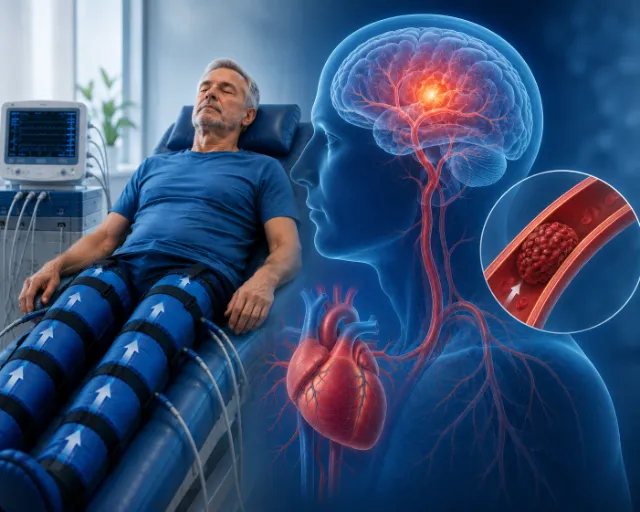
The deep brain regions that control movement are supplied by very small vessels. Damage that develops in these vessels over the years, or small strokes, can lead to Parkinson-like symptoms. Tremor is usually absent or mild in this picture.
Deep white matter
Small vessel damage in the deep regions of the brain appears as white matter changes on MRI. This is the most common cause of vascular Parkinson's.
Small strokes
Small strokes in the movement centers can sometimes cause Parkinson-like symptoms that start suddenly.
Walking and balance
Walking with small, shuffling steps and loss of balance are typical. The risk of falls increases because of this.
Hover over or tap the cards: the related area is highlighted in the illustration.
Neck vessels
Disease in the vessels that supply the brain is also evaluated. The risk factors are the same as for stroke and are treated together.
Blood pressure and heart
High blood pressure is one of the main factors that wear down the small brain vessels. That is why evaluation of the heart and blood pressure is important.
Thinking and memory
According to the review, thinking and memory problems can also accompany vascular Parkinson's. These symptoms are evaluated and monitored separately.
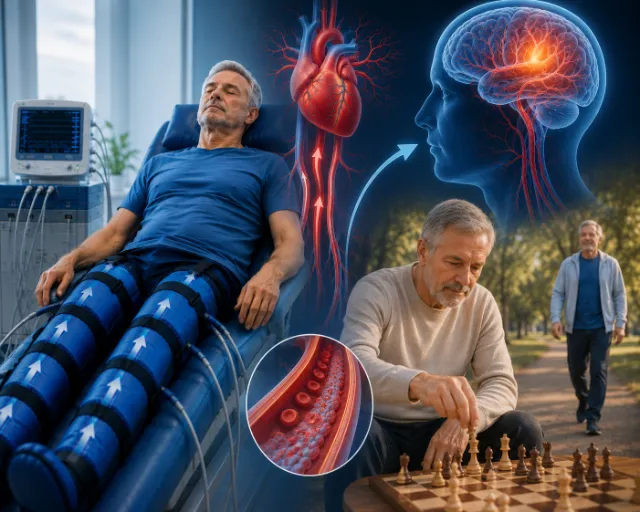
Brain Circulation: Before and With EECP
The comparison below shows in simple form the circulatory support targeted with EECP. Its effect in this disease has not been proven; your progress is monitored with walking and balance tests.
Vascular Parkinson's burden
- Small vessel damage and small strokes
- Gait disorder and falls
- Limited response to treatment
Support alongside rehabilitation
- The aim is to support flow to the brain vessels
- Physiotherapy and medication continue
- Walking and balance are monitored with tests
Schematic illustration. EECP does not reverse damage in the brain; it does not replace neurological treatment.
How Is EECP Applied?
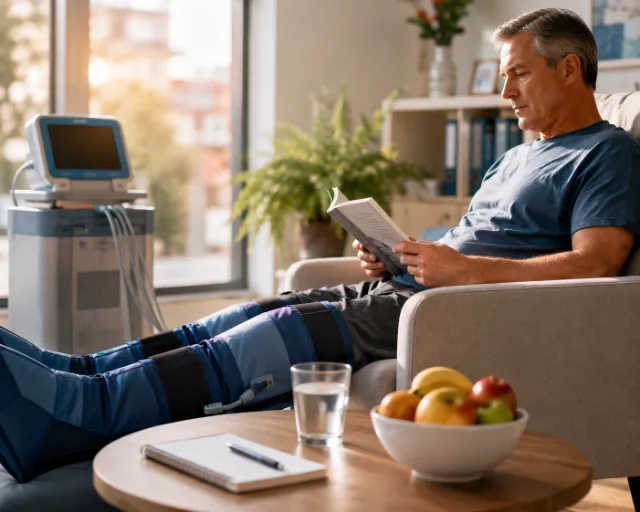
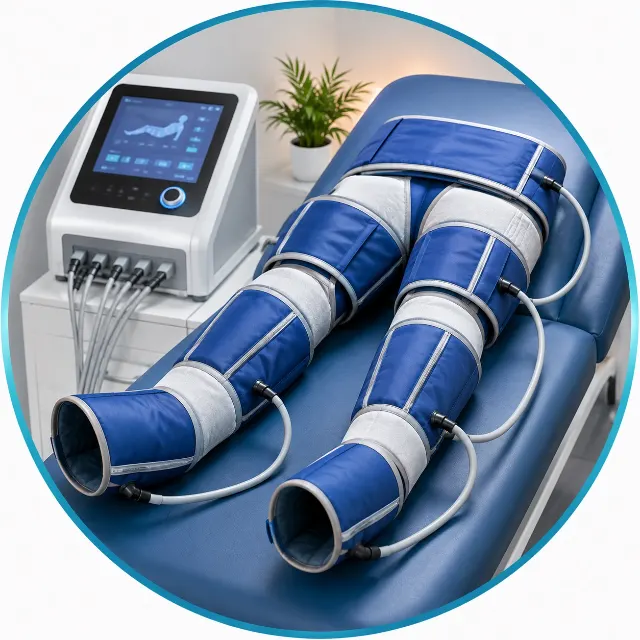
During treatment you lie down and rest. The device monitors your heart rhythm with an ECG and controls the cuffs accordingly.
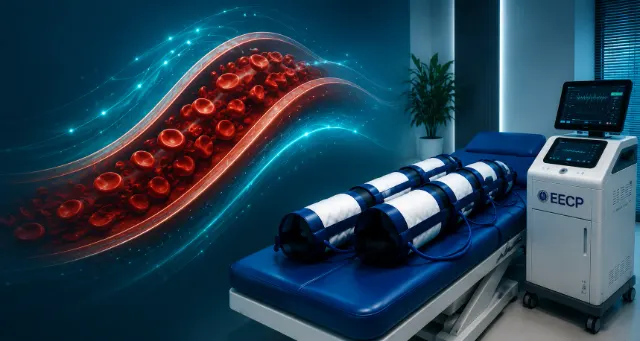
Cuffs inflate
While the heart relaxes, the cuffs on the calves, thighs and buttocks inflate in sequence: first the calves, then the thighs and buttocks.
Blood is directed toward the head
The pressure that rises while the heart relaxes also reaches the vessels that supply the brain. The result of this effect in vascular Parkinson's is unknown.
The heart's workload is reduced
The pressure is released just before the heart contracts, so the heart can pump more easily. This cycle repeats with every heartbeat.
Movement is monitored
Walking, balance and fall risk can be compared with tests before and after the course. The evaluation is done with your neurologist.
What Is Known?
Below we summarize the key information about the disease and treatment options.
A different disease
Vascular Parkinson's is distinguished from classic Parkinson's by its different symptoms and brain findings.
Medication response
According to the systematic review, a subgroup of patients responds to Parkinson's medication.
Multifaceted rehabilitation
In 15 Parkinson's patients, walking and balance improved with a 3-week program that included EECP.
Non-surgical and painless
It is applied externally with cuffs; you lie down and rest throughout the session.
Expert opinion
Experts in China state that EECP may be considered in Parkinson's disease.
Safety
Sessions are performed under medical supervision; blood pressure and pulse are measured at every session.
Who Is It Suitable For, and Who Not?
First, the diagnosis is clarified; classic Parkinson's is distinguished from it with a brain MRI and, if needed, special imaging. The decision on EECP is made together with your neurologist and our cardiologist.
✓May be suitable
- Patients diagnosed with vascular Parkinson's by a neurologist
- Patients with signs of small vessel disease on brain MRI who have walking problems
- Patients continuing physiotherapy whose blood pressure is under control
- Patients who developed Parkinson-like symptoms after a small stroke and are under neurology follow-up
✕Not suitable
- Aneurysm in a brain vessel
- Patients too restless to lie still throughout a session
- Severe aortic valve regurgitation
- Aortic aneurysm
- Active deep vein thrombosis, vein inflammation
- Uncontrolled high blood pressure
- Severe rhythm disorders
- Marked bleeding tendency and pregnancy
How Does the Treatment Process Work?
Blood pressure and pulse are checked before every session. At the end of the course, results are reviewed with our cardiologist. The session schedule is arranged to fit your physiotherapy program.
Frequently Asked Questions About Vascular Parkinson's and EECP
What is the difference between vascular Parkinson's and Parkinson's disease?
Vascular Parkinson's results from cerebrovascular disease; symptoms appear mostly in the legs and tremor is rare. The neurologist makes the distinction with MRI and, if needed, special imaging.
Does EECP improve vascular Parkinson's?
We have not read a controlled study examining EECP in this disease. The limited data in Parkinson's patients also do not isolate the effect of EECP alone. That is why we keep expectations realistic.
Should I stop my Parkinson's medication?
No. Your medication continues according to your neurologist's plan. According to the review, some patients respond to these medications.
Should I continue physiotherapy?
Yes. Walking and balance exercises are an important part of treatment. EECP does not replace them; session times are planned to fit your physiotherapy.
How does this page differ from the Alzheimer's and Parkinson's page?
That page covers memory and Parkinson's disease in general. This page focuses on movement disorder caused by cerebrovascular disease.
How many sessions are needed?
The standard course is 35 sessions: 5 days a week, 60 minutes per session. The plan is aligned with your neurologist and your physiotherapy program.
You May Also Be Interested In



Contact us for a free preliminary assessment
If you have been diagnosed with vascular Parkinson's and are curious about EECP, contact us with your MRI and neurology reports. Our cardiologist evaluates your suitability and discusses expectations openly.
- Non-surgical
- Painless
- Under medical supervision
- Nicosia, Cyprus