
Vascular Alzheimer's and Parkinson's and EECP
Disease of the brain's vessels can contribute to memory and movement problems. EECP is a non-surgical circulatory support that may be added to medication. In Alzheimer's the first controlled results are promising; in Parkinson's the evidence is very limited.
- Non-surgical
- 35 Sessions
- Painless
In brief
It may support treatment in Alzheimer's and Parkinson's disease linked to blocked brain vessels and may help ease symptoms.
It does not replace neurological medication; it is considered in addition to your neurologist's plan.
In early-stage Alzheimer's, a sham-controlled study found a benefit in daily living and one memory test.
For Parkinson's we found no controlled study. The overall level of evidence is limited.
How Do Vessels Affect Memory and Movement?
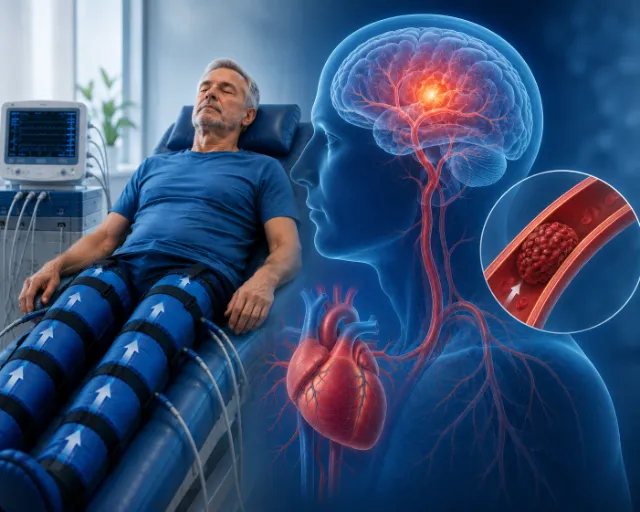
The brain is one of the organs that needs the most blood and oxygen. Disease in the large and small brain vessels can disturb the nourishment of nerve cells. This can accompany the symptoms of Alzheimer's and Parkinson's.
Memory centres
In Alzheimer's, the first areas affected are those related to memory. Forgetfulness and difficulty finding one's way are among the early signs.
Small brain vessels
High blood pressure and diabetes wear down the brain's small vessels. This damage can be seen on MRI as white matter changes.
Neck vessels
Most of the blood going to the brain passes through the carotid arteries. Narrowing here can reduce brain circulation.
Hover over or tap the cards: the related area is highlighted in the illustration.
Heart
When the heart pumps insufficiently, blood going to the brain can also decrease. For this reason heart and brain health are considered together; a heart assessment is also done before treatment.
Vessel stiffness
Atherosclerosis progresses in the brain just as it does throughout the body. The risk factors are the same for heart and brain.
Walking and balance
In Parkinson's, steps become shorter and balance can be impaired. In vascular forms, walking in particular can be affected.
Brain Circulation: Before and With EECP
The comparison below simply illustrates the circulatory support EECP aims to provide. The effect varies from person to person; progress is followed with memory tests and daily-living scales.
Vascular burden
- Narrowing and stiffening of brain vessels
- Forgetfulness, attention and movement problems
- Difficulty with daily tasks
Supported brain circulation
- Flow stimulus to the inner vessel lining
- Neurological medication continues unchanged
- Progress is followed with tests
Schematic illustration. EECP does not remove Alzheimer's or Parkinson's disease.
How Does EECP Support Brain Circulation?
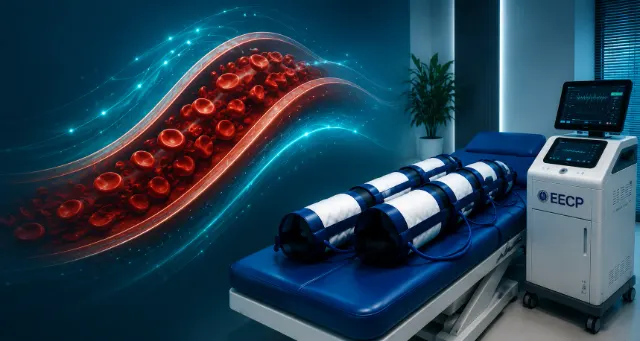
During treatment you lie down and rest. The device monitors your heart rhythm with an ECG and controls the cuffs accordingly.
Cuffs inflate
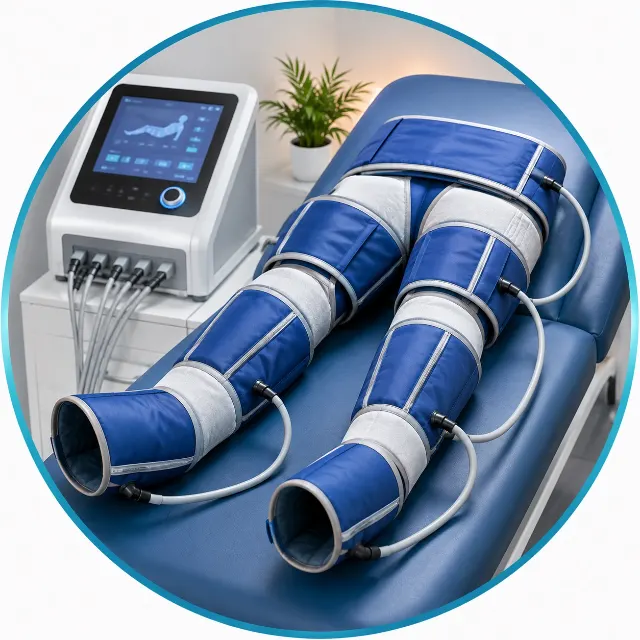
While the heart relaxes, the cuffs on the calves, thighs and buttocks inflate in sequence: first the calves, then the thighs and buttocks.
Blood flow increases
With the pressure that rises while the heart relaxes, flow in the vessels speeds up. The increased flow stimulates the inner vessel lining in a way similar to exercise.
The heart's workload is reduced
The pressure is released just before the heart contracts, so the heart can pump more easily. This cycle repeats with every heartbeat.
Memory and daily life are monitored
Memory tests and daily-living scales are compared before and after the course. The assessment is made together with your neurologist.
What Has Been Reported in Studies?
Response varies from person to person. The following are aims and gains reported in studies.
Daily living skills
In patients with early-stage Alzheimer's, the daily-living score progressed better than with sham treatment.
Memory and thinking test
In the same study, significant improvement was seen in a memory and thinking test at weeks 12–24.
Persistence of the effect
Although treatment ended at month 6, the benefit continued until week 52.
Well-tolerated application
In the study of 190 patients, EECP was well tolerated.
Cognitive decline after stroke
In a retrospective study, memory tests improved more in patients who had EECP added.
Parkinson's
In a small uncontrolled study reported in an expert opinion, symptoms decreased in most patients.
Who Is It Suitable For, and Who Not?
The neurological diagnosis and stage are clarified first; brain MRI and vessel assessment are reviewed. The decision on EECP is made together with your neurologist and our cardiologist. The patient's ability to cope with the sessions is also assessed.
✓May be suitable
- Patients diagnosed with mild cognitive impairment or early-stage Alzheimer's
- Patients with vascular changes found on brain MRI
- Parkinson's patients followed by their neurologist for whom circulatory support is being considered
- Patients who have developed memory and attention problems after a stroke and whose blood pressure is under control
✕Not suitable
- Aneurysm in a brain vessel
- Patients too restless to lie still throughout a session
- Severe aortic valve regurgitation
- Aortic aneurysm
- Active deep vein thrombosis, vein inflammation
- Uncontrolled high blood pressure
- Severe rhythm disorders
- Marked bleeding tendency and pregnancy
How Does the Treatment Process Work?
Blood pressure and pulse are checked before every session. Memory tests are repeated before and after the course; results are reviewed together with our cardiologist and your neurologist. Relatives can stay with the patient during the first sessions.
Common Questions About Alzheimer's, Parkinson's and EECP
Does EECP treat Alzheimer's?
It does not remove the disease. In a sham-controlled study of 190 patients with early-stage Alzheimer's, better results were obtained in daily living and one memory test. This promising finding needs to be confirmed by other studies.
Is there evidence for Parkinson's?
Evidence in Parkinson's is very limited. Apart from a small uncontrolled study reported in an expert opinion, we found no controlled study.
What does “vascular” mean?
It describes cases in which disease of the brain's vessels contributes to memory or movement problems. Brain MRI and vessel assessment are done to understand this.
At which stage is it more meaningful?
The randomized study examined patients with mild cognitive impairment and mild Alzheimer's. Its effect in advanced stages is unknown. For this reason early assessment matters.
Should I stop my medication?
No. You continue your Alzheimer's and Parkinson's medication as recommended by your neurologist; EECP does not replace medication. Only your doctor decides on medication changes.
How many sessions are needed?
The standard course is 35 sessions: 5 days a week, 60 minutes per session. In the Alzheimer's study, two sessions a week were continued after the 35 sessions until month six.
You May Also Be Interested In


Contact us for a free preliminary assessment
If someone close to you has memory or movement problems and you are curious about EECP, contact us. Let's review neurology reports, the medication list and MRI results together. If EECP is not suitable, we will say so clearly.
- Non-surgical
- Painless
- Under medical supervision
- Nicosia, Cyprus